Philip
Washington BlackPhilip, Titch’s cousin, is a man of privilege whose apparent dullness and eccentric appetites conceal a history of mistreatment, unexpected charitable giving, and profound isolation. His suicide at Faith Plantation is witnessed by Washington Black, who is left fearing the consequences of having been present at a white man’s death; much later, Titch’s account of their childhood exposes the cruelty that helped shape Philip’s life and the guilt that survives his death.
Identity and Introduction
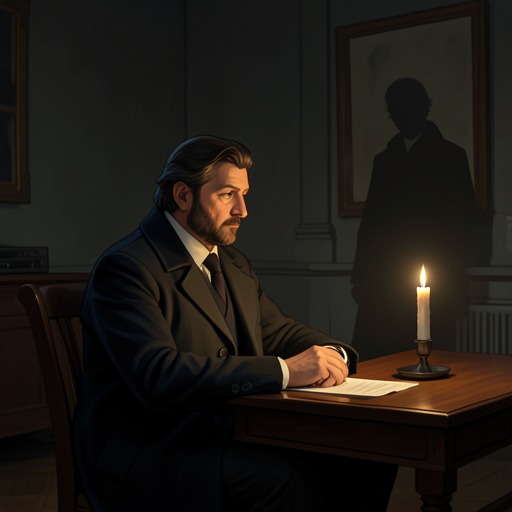
Philip arrives from Kingston after sending word of his imminent visit to Faith Plantation. Titch reacts to the news with abrupt silence and alarm, as though the cousin’s arrival were a visitation. When Washington sees Philip at the harbour, he recognizes in him Titch’s finely boned face, black hair, and jade-coloured eyes, but also notices a more cautious expression and a heavier build. The resemblance is real, but Philip’s manner and appearance strike Washington as distinctly his own.
At the plantation, Philip describes the place as dreary and seems to regard the world with mild dissatisfaction. Washington later understands him as a man of his class, living from one day to the next with passions that amount more to distractions than deep commitments. Philip can fall into long grey silences, and he speaks little to Washington beyond giving soft commands. His social standing separates him from the enslaved boy whose drawings he will eventually notice, even as Philip himself remains difficult for those around him to understand.
Habits and Contradictions
Philip is absorbed in food and his shotgun. On collecting expeditions with Titch, he carries the gun and attempts to hunt, taking better care of it than of his own appearance. His expensive clothes are often put on carelessly, with a button or string left hanging, while his appetites are both broad and particular: he eats large quantities of local dishes and sweets, sleeps late, and spends afternoons in a rocking chair with lemon water. He makes requests for food with unusual deliberation, and his attention to such comforts appears almost fanatical.
That portrait is not the whole of him. After Philip’s death, Titch learns that he had donated half his income each month to a ladies’ aid society that ran a home for orphaned children, even while carrying substantial gambling debts in Whitechapel. Philip also claimed to be engaged to a widow in Lisbon, though no one could find evidence that she existed. He frequented disreputable clubs, spent freely, and had no friends. Titch cannot reconcile these details into a clear account of his cousin: they show a private life whose generosity, debts, appetites, and claims resist a single interpretation.
Philip’s response to Washington’s drawing offers a rare interruption in his reserve. While Washington sketches beside Titch, Philip glimpses the work, takes the paper, and examines it in amazement. The moment does not erase the distance between them, but it shows him attending to something beyond his usual preoccupations.
Childhood with Titch and Erasmus
Much later, Titch tells Washington that he, Philip, and Erasmus were close as boys and played together like brothers. Yet Titch and Erasmus did not treat Philip as an equal: his family was poorer and his manners less refined, and the boys used those differences to mock him. Their pranks became deliberate humiliations. They told Philip that parts of their estate were haunted and locked him overnight in a disused room; on another outing, they took him into the woods, made him undress, and left him to walk home naked after he began to cry.
The cruelty escalated into beatings. Titch recalls that Erasmus in particular would keep punching Philip after he had fallen, stopping only when Philip lost consciousness. He admits that the boys had acquired a taste for the violence and could not stop. Titch wonders whether this was where Erasmus’s later violence began, but the account also makes Titch’s own participation unmistakable. His retrospective shame does not make him an innocent observer: he says that he and Erasmus were awful to Philip and recognizes the harm as something they did together.
One episode leaves Titch with a particular burden of regret. On the night Philip’s father was dying, Philip resisted going out with the cousins because he had stayed by his sick father for weeks. Titch and Erasmus insisted, and Philip eventually joined them at a public house. He returned to Grosvenor half-blind with drink and learned that his father had died. Titch recalls this episode alongside the later suicide, leaving the earlier coercion and the final death connected by his memory, though he does not claim the childhood outing alone explains Philip’s fate.
Death at Faith Plantation
At Faith Plantation, Philip proposes buying Washington from Erasmus, asking what Erasmus would accept for the boy. Titch quietly asks that the matter be left alone. Erasmus then turns the exchange into a taunt, speculating about Titch’s attachment to Washington and directing a degrading question at the boy. Philip’s intervention thus occurs within the plantation’s ownership structure: he treats Washington as someone who might be bought, even as his question challenges Erasmus’s claim to keep him.
Later, Philip approaches Washington and a young woman in the field carrying his shotgun. Washington has been trying not to dwell on Erasmus’s alarming demand that he be returned. Philip calls out, then arrives looking tired and diminished despite the intensity in his eyes. The scene culminates in Philip’s suicide. Washington survives the blast but is left as the sole witness to the death of a white man. His immediate fear is not only grief or horror: he understands that his presence may expose him to danger, and the death becomes entangled with his own precarious effort to escape enslavement.
As Titch and Washington flee aboard a ship, Washington cannot stop thinking about Philip or Erasmus. He feels uneasy that he alone witnessed the death and fears that the Kinasts may discover where the fugitives came from. Titch has claimed Washington as his property as part of their ruse, and Washington recognizes how unnerving that lie is even while acknowledging its practical necessity. Philip’s death therefore follows them not as a resolved episode but as a source of fear, guilt, and disrupted lives.
Aftermath and Narrative Significance
Titch eventually tells Washington that his father called Philip too thoughtful for his own good after hearing of the death. Titch reads that response as evidence of his father’s coldness, but his account also forces Washington to reconsider who bears responsibility for the past. Washington had felt responsible for Philip’s death despite having laid no hand on him; Titch’s confession redirects attention to the cruelty inflicted on Philip by the cousins and to the unequal conditions under which Washington himself had lived.
When Titch recalls retrieving Philip’s body, he says he could not touch him and thought that the remains were not Philip. The experience unsettled his former sense that the physical world was all there was. Philip’s death thus marks not only Washington’s fear and Titch’s remorse but also Titch’s confrontation with the limits of a purely material understanding of a person.
Philip matters to the novel less as a fully knowable personality than as a presence whose meaning changes with each disclosure. At first he appears to Washington as an odd, privileged visitor; his death makes him the center of a traumatic flight; Titch’s later recollections reveal both the violence Philip endured and the violence Titch helped inflict. The contrast between Philip’s private generosity and his isolation, and between Titch’s childhood cruelty and adult remorse, keeps his life from resolving into a simple portrait of either victimhood or eccentricity.